
Blog
The Science Behind Why Hands-On Lab Training Produces Better IT Professionals
- May 30, 2026
- Posted by: newmacobitdxb
- Category: Uncategorized
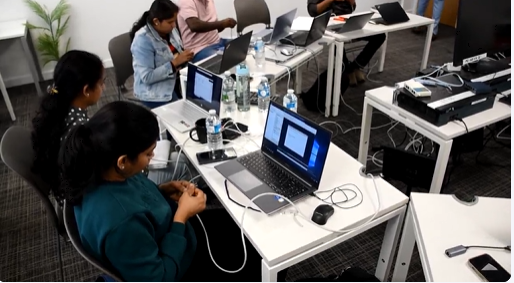
There has never been more access to IT education than there is right now.
YouTube tutorials. Online course platforms. Free certification prep materials. AI-powered learning tools. The promise is simple — learn IT from your laptop, at your own pace, for a fraction of the cost of structured training.
And millions of people take that offer every year.
Yet hiring managers across the UAE and the wider Gulf region consistently report the same frustrating experience. Candidates arrive at interviews with certificates, course completion badges, and hours of video content consumed — and cannot answer a basic practical question. Cannot troubleshoot a simple network issue. Cannot configure a service they have watched configured dozens of times on screen.
The problem is not the candidate. The problem is the method.
There is a significant and well-documented difference between consuming information and building capability. Between watching someone configure a server and actually configuring one yourself. Between knowing what to do and being able to do it under pressure, in an unfamiliar environment, with real consequences.
This article explains the science behind that difference — and why hands-on lab training is not just a nice addition to IT education. It is the foundation that everything else depends on.
The Brain Does Not Learn by Watching
Let us start with the science — because it is more straightforward than most people expect.
When you watch a tutorial, your brain processes information passively. It recognises patterns, follows along, and creates a feeling of understanding that psychologists call the fluency illusion. The content makes sense as you watch it. The steps seem logical. You feel like you have learned something.
But feeling like you have learned something and actually being able to perform it are two entirely different neurological states.
Active learning — where you are physically doing something, making decisions, encountering problems, and working through them — engages a fundamentally different part of the brain. It creates what neuroscientists call procedural memory — the same type of memory that allows you to ride a bicycle, type without looking at the keyboard, or drive a familiar route without consciously thinking about every turn.
Procedural memory is durable. It survives under pressure. It is retrievable when you are stressed, tired, or in an unfamiliar environment. It is exactly the kind of memory that an IT professional needs when a network goes down, a server fails, or a security incident unfolds in real time.
Declarative memory — the kind formed by watching, reading, and listening — is fragile by comparison. It is highly dependent on context. Under pressure, in unfamiliar situations, it is the first thing to fail.
This is not a criticism of people who learn online. It is a description of how the human brain works. And it has direct, practical implications for how IT skills should be built.
The Competence Gap Nobody Talks About
The IT industry has a word for the difference between knowing something and being able to do it reliably under pressure.
It is called competence. And it is built through repetition, feedback, and progressively more challenging real-world scenarios — not through passive consumption of content.
Consider what a networking professional actually needs to do on the job. They need to configure a router under time pressure. Diagnose a connectivity issue they have never seen before in an environment they are not familiar with. Communicate the problem to a non-technical manager while simultaneously working through a solution. Make decisions with incomplete information. Recover from mistakes quickly without escalating the problem.
None of these capabilities are developed by watching tutorials. Every single one of them is developed by doing — repeatedly, in environments that simulate the complexity and pressure of real work.
This is the competence gap. And it is the reason why so many candidates with impressive online learning portfolios struggle in technical interviews and in their first months on the job. They have knowledge. They do not yet have competence. And competence is what employers are paying for.
The best IT training in Dubai programmes understand this distinction and build their entire curriculum around closing it — through structured lab environments where students are not just watching concepts demonstrated but applying them, breaking them, troubleshooting them, and rebuilding them until the capability is genuinely embedded.
What Happens in a Hands-On Lab That Cannot Happen Online
A well-designed IT lab environment does several things that no online course can replicate.
It creates genuine consequences. When you misconfigure a network in a lab, something stops working. You experience the result of your decision, diagnose what went wrong, and correct it. This feedback loop is the core mechanism of skill development. Online courses do not have this. Watching a tutorial does not have this. The lab does.
It builds troubleshooting instinct. Troubleshooting is not a knowledge skill — it is a pattern recognition skill developed through exposure to many different problems over time. Every lab session adds to the bank of scenarios a professional has encountered and worked through. Over weeks and months, this builds the diagnostic intuition that experienced IT professionals seem to have automatically — because they do. It was built through repeated exposure to real problems.
It develops composure under pressure. Working through a technical problem in a lab — where something is genuinely not working and you need to find out why — is a controlled form of the pressure IT professionals experience on the job. Developing the ability to think clearly, work methodically, and remain calm when something is broken is a capability that can only be built through practice. No amount of video content builds it.
It exposes knowledge gaps immediately. Students who watch tutorials often do not know what they do not know until they sit in front of real equipment and discover that the concept they thought they understood does not translate into a working configuration. The lab makes this discovery safe — and early enough in the learning process to correct it before it becomes a problem on the job.
Online Learning vs Structured Lab Training — An Honest Comparison
| Factor | Online Courses | Hands-On Lab Training |
|---|---|---|
| Cost | Lower upfront | Higher — justified by outcomes |
| Flexibility | High | Structured — with flexible options |
| Knowledge delivery | Strong | Strong |
| Practical skill development | Minimal | Core focus |
| Troubleshooting ability | Not developed | Actively developed |
| Interview readiness | Low | High |
| Day one job performance | Inconsistent | Significantly stronger |
| Confidence under pressure | Not built | Built through repetition |
| Employer recognition | Certificate only | Demonstrated capability |
| Long-term career impact | Limited | Compounding |
The cost difference between online learning and structured lab training is real. But the more important question is not what each option costs — it is what each option delivers. A cheaper course that does not produce job-ready capability is not a saving. It is a delay.
How Hands-On Training Changes Your Career Trajectory
The difference between an IT professional who trained in a lab environment and one who learned primarily online does not disappear after the first job. It compounds.
In the first role, the lab-trained professional performs faster, troubleshoots more effectively, and builds confidence more quickly — which leads to earlier recognition, earlier responsibility, and earlier progression.
In subsequent roles, the foundation built through hands-on training continues to accelerate learning. Every new technology, every new environment, every new challenge is easier to approach because the underlying competence — the ability to work through unfamiliar problems methodically — is already established.
This is why the best IT infrastructure courses are consistently built around lab environments rather than video libraries. Not because lab training is more impressive as a marketing concept — but because the professionals it produces are measurably more capable, more employable, and more successful over the course of a career.
At Macob IT Solutions, every programme in our IT infrastructure course in Dubai is structured around this principle. Students do not watch configurations — they perform them. They do not observe troubleshooting — they troubleshoot. The lab is not supplementary to the curriculum. It is the curriculum. And our lab facilities are available beyond standard class hours — because skill development does not operate on a timetable.
The Question Worth Asking Before You Enroll Anywhere
Before you invest your time, money, and career ambitions in any IT training programme — ask one question.
What will I be able to do when I finish — not just what will I know?
If the answer focuses on certificates, course hours, and content modules — ask again. The answer you are looking for describes practical capability. The configurations you will be able to perform. The problems you will be able to diagnose. The environments you will be comfortable working in.
IT courses in Dubai vary significantly in how they answer that question. The ones worth your investment are the ones that can point to what their graduates do — not just what their curriculum contains.
Online learning has a place in professional development. It is a useful supplement for staying current, exploring new topics, and reinforcing concepts. But it is not a substitute for the environment where IT competence is actually built.
That environment is the lab. And the professionals who trained in one consistently outperform those who did not — not because they worked harder, but because they trained smarter.